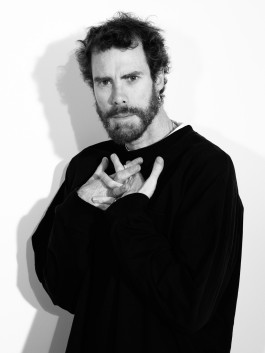
Photographed by Julien Martinez Leclerc
In creative work, especially in a world where cameras are constantly around the body, there is always something visible: an image, a gesture,
a performance, a final result.
But there is also something quieter that remains.
The way someone is seen. The way they are guided into trust.
Australian-born and Paris-based, Ryan Chappell is a movement director, choreographer and consultant whose career has unfolded between dance, fashion and image-making. He began as a professional dancer and choreographer before expanding into fashion through his studies in Fashion Design and Fashion History. Over time, these worlds began to converge, leading him to movement direction and collaborations across some of fashion and music’s most recognized stages.
His practice also extends beyond the set. As the founder of MOVEMENT+, he explores model development through both its performative and psychological dimensions.
In this conversation, movement becomes less about arranging the body and more about understanding the person within it.
A reflection on presence, vulnerability, self- awareness, and the conditions that allow someone not only to move, but to become.

Photographed by Ilya Lipkin
A way of seeing is never formed in isolation. It begins with surroundings, space and habit, with the bodies we encounter and the gestures we recognize long before we understand what they mean.
Where do you come from, and what experiences do you think
first shaped the way you understood movement?
I grew up in a small beach town in Australia, so the body is out all the time. Your body's out. You see the body more often, so you have a connection to it. You can't hide it. My parents were both very active and athletic, so I was always around that. Then I started dancing when I was eight. I started with tap, and went on to classical ballet, modern, musical theatre, acrobatics. I even did Indian dance at one point. Just the way things move has always fascinated me. When I was younger, I was very observant and very shy. I was always watching people. I didn't say a lot, but I used to watch a lot. I think that's also part of how I approach my job and life now. As a movement director, you have to be able to read people, observe them and pick up the tiny nuances to help people find the best in them.

Photographed by Ilya Lipkin
Where we come from inevitably leaves something on the body. Climate, culture and environment shape the way we occupy space. But influence is not the same as truth. Perhaps authenticity begins where what surrounds us meets something we can still recognize as our own.
Do you think there is a way of moving that is more authentic than another?
I think it's very individual. It depends on what you see as authentic and genuine. For me, it's always about who you are in the context. Different cultures have different ways of expressing themselves. There can be passion and joy, or someone can look really stiff. But if they're authentically in that, if that's aligned with who they are, then it's beautiful.
It's not what it is sometimes, but how it's done or how it's approached. I think that's more authentic than trying to be the thing that you think you should be. Especially since social media, everything's so curated and so performative. Everyone's worried they're going to look a particular way, or they're not going to be appreciated in the right way. So we lose this sense of really deep connection to our authentic self.
“HOW WILL IT LOOK? BUT HOW DOES IT FEEL?”

Photographed by Ilya Lipkin
The body can belong to us and still become something we watch from the outside. The moment instinct becomes image, movement begins to negotiate with perception: how we look, how we are being seen, and whether what appears will be accepted.
If movement had an enemy, would it be self-awareness?
Yes, 100%.
Self-awareness can be used as a concept. Especially in fashion, you can push it and create something particular from it. But when we become too self-aware, we lose the magic.
You see it when you're connecting with someone and suddenly they laugh or do something, and you can see that it's really authentically them. That's one of the biggest parts of my job - trying to help people get to a place where they can be in those moments.
You look at some of the best fashion images, the images people go back to again and again, and there's some combination of emotion and facial expression. Even if there's not a lot of movement in the body, there's something really powerful in the expression. It can be the smallest nuance.
I think now we live in a culture that is so hyper-aware that everything becomes overthought.
We need to get back into our bodies and into our heart space.

Photographed by Ilya Lipkin

Photographed by Ilya Lipkin
Not every movement begins with intention. Before the gesture, there is already something moving us - an emotion,
a memory, an insecurity, a sense of confidence. What becomes visible in the body often begins somewhere we cannot see.
Do you think there is something happening before a body moves?
Oh, a hundred percent. Everything's always moving. Even something that seems solid, if you get deep enough, there are particles moving inside it. But I also think the way that we move definitely comes from something. It always does. Even our habits, the way we move our hands, the way that we are - it's come from a whole learned blueprint. Sometimes it's so deeply subconscious that we don't even realize it. Whether it comes from insecurity, confidence or an attitude, you can see it. When somebody walks down the street, you can see whether they're happy, whether they feel sexy, whether they're having a great day, whether they feel really hot in their new shoes. You can feel that. Even in a still image, it matters. You can put someone into a pose, but how are they being in the pose? What are they thinking about? How are they breathing? Those things are picked up. The smallest nuance can change something in an image. It gives you something you can't quite put your finger on.
"IT COMES FROM SOMETHING. IT ALWAYS DOES."


To direct someone, perhaps you have to see them before you ask them to become anything. Movement direction begins somewhere between observation and trust.
How much of movement direction is actually about understanding the person before understanding their body?
My job is basically, in many ways, very psychological. I meet people sometimes that I've never met before. I have to create bonds and a form of trust very, very fast. I have to understand where they
are, who they are, where their insecurities are and where we can go. Then I have to try and help lead them into places that maybe aren't always comfortable for them. So I have to be very vigilant. I have to be watching. Sometimes in my job there are groups. I might have to make five people look like best friends when they've never met one another. So you have to manage energies and try to connect people. You can physically match people together, but then it becomes an energetic feeling. There are these subliminal things. They're there, and they're the things that actually make things magical.
"I HAVE TO CREATE BONDS AND CREATE A FORM OF TRUST VERY, VERY FAST."

Beyond the image, the movement and the final result, there is what stays with us once the work is over. Perhaps the value of creating is not only in what we make, but in what another person is able to carry away from it.
When you go to bed at night, what is it about your job, about movement, about working with models and in fashion, that makes you feel fulfilled?
That's very easy. I wouldn't do this job if I didn't actually feel like I was helping someone. I spent many years as a performer, with people clapping for me. But I reached a point where I started getting much more joy from making other people feel like they matter. Especially with models, the work has given me so much joy. Sometimes I meet them before they've even been launched, when they're still trying to understand themselves and find their place within the industry. For me, it's never about doing the work for them. My job is to give them tools, mentally and physically, and then let them take those tools somewhere of their own. Now enough years have passed that I've been able to watch some of those people grow, take ownership of themselves and thrive. There's something really beautiful about seeing that happen and knowing that, maybe, you gave them a little push at the beginning. That's the part that makes me feel great. That's why I do my job.
"I GET SO MUCH JOY OUT OF MAKING PEOPLE FEEL LIKE THEY MATTER."
Perhaps the deeper we look, the less there is to resolve. Movement can be observed, directed and questioned, but it does not always need to be understood. There is something lost when experience becomes something we are constantly trying to explain.
What are you still trying to understand about movement?
I think I've spent a lot of my life trying to understand things - searching for the truth, searching for the reason why things are the way they are. But I'm getting more to the point where I just want to observe things. To accept them and embrace them rather than always trying to understand them. You can analyse something beautiful so much that you almost miss the beauty of it. Sometimes the experience itself is enough. Movement is always there. The way we move changes depending on context - where we are, what we're wearing, the culture we're in, the time we're living in. All of those things inform it. I'm becoming less interested in breaking everything down and more interested in letting things be, letting them move, letting them flow.
"SOMETIMES THE EXPERIENCE ITSELF IS ENOUGH."

Photographed by Ilya Lipkin
Taking up space, becoming something or someone else, feels almost natural in the world we live in. But at the end of the day, movement, whether in an industry built around being seen, through the eyes of others, or in the privacy of daily life, is the way we exist. In an era where everyone is behind a camera or under someone else’s gaze, doubt begins to occupy more and more space in the mind and, in doing so, leaves less space for the body. Movement begins to lose some of its magic when watching ourselves becomes more important than simply experiencing it. In fashion and image-making, where so much is created to be looked at, what happens before the final image may be just as important as what remains in it. Authenticity, instinct, and true movement lie in remembering that, even when performing or trying to communicate something, what matters is embracing what feels right, allowing who someone is to come before who they think they are supposed to be.

September, 2026
ACROSS paris & madrid
By sofia bosque
In creative work, especially in a world where cameras are constantly around the body, there is always something visible: an image, a gesture,
a performance, a final result.
But there is also something quieter that remains.
The way someone is seen. The way they are guided into trust.
Australian-born and Paris-based, Ryan Chappell is a movement director, choreographer and consultant whose career has unfolded between dance, fashion and image-making. He began as a professional dancer and choreographer before expanding into fashion through his studies in Fashion Design and Fashion History. Over time, these worlds began to converge, leading him to movement direction and collaborations across some of fashion and music’s most recognized stages.
His practice also extends beyond the set. As the founder of MOVEMENT+, he explores model development through both its performative and psychological dimensions.
In this conversation, movement becomes less about arranging the body and more about understanding the person within it.
A reflection on presence, vulnerability, self- awareness, and the conditions that allow someone not only to move, but to become.

Photographed by Julien Martinez Leclerc
A way of seeing is never formed in isolation. It begins with surroundings, space and habit, with the bodies we encounter and the gestures we recognize long before we understand what they mean.
Where do you come from, and what experiences do you think
first shaped the way you understood movement?
I grew up in a small beach town in Australia, so the body is out all the time. Your body's out. You see the body more often, so you have a connection to it. You can't hide it. My parents were both very active and athletic, so I was always around that. Then I started dancing when I was eight. I started with tap, and went on to classical ballet, modern, musical theatre, acrobatics. I even did Indian dance at one point. Just the way things move has always fascinated me. When I was younger, I was very observant and very shy. I was always watching people. I didn't say a lot, but I used to watch a lot. I think that's also part of how I approach my job and life now. As a movement director, you have to be able to read people, observe them and pick up the tiny nuances to help people find the best in them.

Photographed by Ilya Lipkin
Where we come from inevitably leaves something on the body. Climate, culture and environment shape the way we occupy space. But influence is not the same as truth. Perhaps authenticity begins where what surrounds us meets something we can still recognize as our own.
Do you think there is a way of moving that is more authentic than another?
I think it's very individual. It depends on what you see as authentic and genuine. For me, it's always about who you are in the context. Different cultures have different ways of expressing themselves. There can be passion and joy, or someone can look really stiff. But if they're authentically in that, if that's aligned with who they are, then it's beautiful.
It's not what it is sometimes, but how it's done or how it's approached. I think that's more authentic than trying to be the thing that you think you should be. Especially since social media, everything's so curated and so performative. Everyone's worried they're going to look a particular way, or they're not going to be appreciated in the right way. So we lose this sense of really deep connection to our authentic self.
“HOW WILL IT LOOK? BUT HOW DOES IT FEEL?”

Photographed by Ilya Lipkin
The body can belong to us and still become something we watch from the outside. The moment instinct becomes image, movement begins to negotiate with perception: how we look, how we are being seen, and whether what appears will be accepted.
If movement had an enemy, would it be self-awareness?
Yes, 100%.
Self-awareness can be used as a concept. Especially in fashion, you can push it and create something particular from it. But when we become too self-aware, we lose the magic.
You see it when you're connecting with someone and suddenly they laugh or do something, and you can see that it's really authentically them. That's one of the biggest parts of my job - trying to help people get to a place where they can be in those moments.
You look at some of the best fashion images, the images people go back to again and again, and there's some combination of emotion and facial expression. Even if there's not a lot of movement in the body, there's something really powerful in the expression. It can be the smallest nuance.
I think now we live in a culture that is so hyper-aware that everything becomes overthought.
We need to get back into our bodies and into our heart space.

Photographed by Ilya Lipkin

Not every movement begins with intention. Before the gesture, there is already something moving us - an emotion,
a memory, an insecurity, a sense of confidence. What becomes visible in the body often begins somewhere we cannot see.
Do you think there is something happening before a body moves?
Oh, a hundred percent. Everything's always moving. Even something that seems solid, if you get deep enough, there are particles moving inside it. But I also think the way that we move definitely comes from something. It always does. Even our habits, the way we move our hands, the way that we are - it's come from a whole learned blueprint. Sometimes it's so deeply subconscious that we don't even realize it. Whether it comes from insecurity, confidence or an attitude, you can see it. When somebody walks down the street, you can see whether they're happy, whether they feel sexy, whether they're having a great day, whether they feel really hot in their new shoes. You can feel that. Even in a still image, it matters. You can put someone into a pose, but how are they being in the pose? What are they thinking about? How are they breathing? Those things are picked up. The smallest nuance can change something in an image. It gives you something you can't quite put your finger on.
"IT COMES FROM SOMETHING. IT ALWAYS DOES."


To direct someone, perhaps you have to see them before you ask them to become anything. Movement direction begins somewhere between observation and trust.
How much of movement direction is actually about understanding the person before understanding their body?
My job is basically, in many ways, very psychological. I meet people sometimes that I've never met before. I have to create bonds and a form of trust very, very fast. I have to understand where they
are, who they are, where their insecurities are and where we can go. Then I have to try and help lead them into places that maybe aren't always comfortable for them. So I have to be very vigilant. I have to be watching. Sometimes in my job there are groups. I might have to make five people look like best friends when they've never met one another. So you have to manage energies and try to connect people. You can physically match people together, but then it becomes an energetic feeling. There are these subliminal things. They're there, and they're the things that actually make things magical.
"I HAVE TO CREATE BONDS AND CREATE A FORM OF TRUST VERY, VERY FAST."

Beyond the image, the movement and the final result, there is what stays with us once the work is over. Perhaps the value of creating is not only in what we make, but in what another person is able to carry away from it.
When you go to bed at night, what is it about your job, about movement, about working with models and in fashion, that makes you feel fulfilled?
That's very easy. I wouldn't do this job if I didn't actually feel like I was helping someone. I spent many years as a performer, with people clapping for me. But I reached a point where I started getting much more joy from making other people feel like they matter. Especially with models, the work has given me so much joy. Sometimes I meet them before they've even been launched, when they're still trying to understand themselves and find their place within the industry. For me, it's never about doing the work for them. My job is to give them tools, mentally and physically, and then let them take those tools somewhere of their own. Now enough years have passed that I've been able to watch some of those people grow, take ownership of themselves and thrive. There's something really beautiful about seeing that happen and knowing that, maybe, you gave them a little push at the beginning. That's the part that makes me feel great. That's why I do my job.
"I GET SO MUCH JOY OUT OF MAKING PEOPLE FEEL LIKE THEY MATTER."
Perhaps the deeper we look, the less there is to resolve. Movement can be observed, directed and questioned, but it does not always need to be understood. There is something lost when experience becomes something we are constantly trying to explain.
What are you still trying to understand about movement?
I think I've spent a lot of my life trying to understand things - searching for the truth, searching for the reason why things are the way they are. But I'm getting more to the point where I just want to observe things. To accept them and embrace them rather than always trying to understand them. You can analyse something beautiful so much that you almost miss the beauty of it. Sometimes the experience itself is enough. Movement is always there. The way we move changes depending on context - where we are, what we're wearing, the culture we're in, the time we're living in. All of those things inform it. I'm becoming less interested in breaking everything down and more interested in letting things be, letting them move, letting them flow.
"SOMETIMES THE EXPERIENCE ITSELF IS ENOUGH."

Photographed by Ilya Lipkin
Taking up space, becoming something or someone else, feels almost natural in the world we live in. But at the end of the day, movement, whether in an industry built around being seen, through the eyes of others, or in the privacy of daily life, is the way we exist. In an era where everyone is behind a camera or under someone else’s gaze, doubt begins to occupy more and more space in the mind and, in doing so, leaves less space for the body. Movement begins to lose some of its magic when watching ourselves becomes more important than simply experiencing it. In fashion and image-making, where so much is created to be looked at, what happens before the final image may be just as important as what remains in it. Authenticity, instinct, and true movement lie in remembering that, even when performing or trying to communicate something, what matters is embracing what feels right, allowing who someone is to come before who they think they are supposed to be.