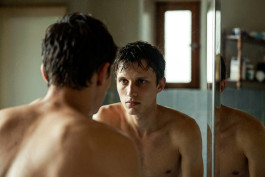
If fashion is a reflection of its time, what happens when the photographic studio shifts to code?
The hours between subverts authorship and process.
We talk with Fabrizio Rigamonti, the AI artist behind this editorial, about analog memory,
the limits of the industry, and the temptation of synthetic perfection.
Looking back at your family environment and the place where you grew up, what was the first image that made you grasp the authority of aesthetics before you even had a word for art?
I grew up in a small town in Brianza, in northern Italy, where aesthetics didn’t really have a place in everyday life. So when I think about the first time I remember noticing aesthetics, I don’t think of an exhibition or a magazine. I think of a pair of ballet flats. I was in the first years of primary school. We were asked to write about something that had caught our attention, and while everyone else wrote about their holidays or their favourite games, I described my teacher Grazia’s ballet flats in meticulous detail. They were glossy orange, with two little fish made of colourful sequins on the toes. I still remember them perfectly. And when I happened to run into her many years later, the first thing she told me was that she still remembered that essay.
How do you recall the cadence of your childhood in terms of texture and physical contact, and how does that sensory memory inform the way you construct synthetic imagery today?
Being born in 1998, I grew up during the transition between a still deeply analogue childhood and the technology- driven world we live in today. I’m quite a nostalgic person, and I often find myself looking back. A lot of my ideas start there. I love using all the tools that technology gives us, but I’m not interested in using them to create deliberately impossible or surreal images. What fascinates me is creating something that could actually feel real. Maybe that’s what my analogue upbringing still gives me. Even when I’m working with entirely digital tools, I’m always looking for believable light, a certain grain, and colours that feel natural. For me, technology should help make an image possible, not become the image itself.
Our relationship with fashion often stems from a fundamental tension: the desire to assimilate or the urge to set oneself apart.
In your youth, is clothing a mechanism for fitting into your surroundings, or is it a language designed to carve out a boundary against them?
As a child, and for most of my teenage years, I always tried to dress more or less like my peers.
All it took was wearing something slightly different for someone to point it out. For a long time, I tried to avoid that kind of attention,
even though I was always drawn to things that felt a little out of the ordinary. Today, I just dress how I want, without thinking too much about it.
The best example is what happens every time I visit my grandmother. As soon as she sees me wearing my Tabi shoes,
she looks at me and says, “Ussingur, se l’è cus’è?” In our dialect, it means, “Oh my God, what is that?”


Every artist experiences a moment of disillusionment with the traditional mediums through which they first learned to operate.
What structural limits or frictions did you encounter in your earlier work that made you realize traditional photography or design was no longer adequate to capture your vision?
Creatively, I’ve never really felt limited. If anything, the limitations come when you have to deal with time and budget.
I started using AI because it allows me to explore those ideas without having to scale them back from the very beginning. More and more often, clients are working with tighter budgets and leaner productions, and AI lets me create images that would normally require a much bigger production.
I also love how fast the process is. Being able to see an idea take shape almost immediately completely changes the way you develop it.
You can experiment, change things, go back, and keep improving it.
For me, it’s not about replacing the way we work. It’s just another tool that lets me develop an idea without having to scale it back from the beginning.
How would you define your distinct visual signature within a medium where everyone is essentially drawing from the same algorithmic well?
I don’t know if I really have a visual signature. What I can talk about is the way I build every image.
Whenever I start a project, I always collect photographs, films, and visual references.
I need to build a world in my head before I even start generating. In my mind, there’s already a scene, a light, and an atmosphere.
The first thing I generate is almost always the characters. I like giving them names, imagining them as real people,
and placing them in a believable context. Before I start generating, I always write a script for myself, scene by scene.
I need to have a very clear idea of where the project is going before I begin. Once the images are ready,
I edit them exactly as I would a photograph, adjusting the light, contrast, colours, and tones until they match what I had imagined.
I like it when someone looks at one of my images, pauses for a moment, and wonders whether it’s real or not.
That’s exactly the feeling I’m looking for.


If you were asked to articulate the core thesis of the story we are publishing in this issue,
how would you frame its conceptual weight to someone encountering it for the first time?
The idea was to tell the story of a weekend away from everyday life. Those few days when you stop looking at the clock and simply enjoy the people around you.
I liked the idea of never completely defining the relationship between the three protagonists. There’s friendship, there’s intimacy, there’s desire, but I never felt the need to explain it or put a label on it.
I think we’re too used to putting everything into a category.
More than telling a specific story, I wanted to capture a feeling. Those moments when you can just be present, enjoy the people around you, and not feel the need to define everything.

Fashion is, at its core, a deeply tactile discipline, When you translate clothing into a synthetic rendering, are you designing fashion,
or are you constructing a mirage of it?
Where does the garment actually exist when there is no fabric?
I think my background as a fashion designer plays a huge role in the way I approach these projects. I still work as a fashion designer today, so fashion is still the starting point of everything I create.
Once I’ve imagined the characters and chosen the locations, the part I enjoy the most is developing the styling. I spend a lot of time researching, looking through archive collections from fashion houses, but also looking at the work of independent designers. Quite often, I start from a garment that actually exists and build the rest of the look around it. For me, styling is never just about writing “black trousers” into a prompt. I’m thinking about the cut, the textures, the way a material reacts to light, the proportions, and the details. The final image might be synthetic, but the process behind it is very real. The research, the references, and every creative decision are exactly the same as they would be in any fashion project.

AI-generated imagery tends toward a pristine, almost surgical perfection. Yet, the history of great style has always relied on imperfection, on the flaw, on what dominant culture deems an 'error.'
How do you prevent artificial intelligence from homogenizing taste and selling us a prefabricated, sterile idea of beauty?
I think the risk is real. If you rely entirely on AI, it’s easy for images to start looking the same.
That’s why I always start with a very clear idea of what I want to create. I gather references, study photography, films, and fashion campaigns, and I already know what I want before I generate anything. I don’t leave much room for AI to make decisions. I’m the one deciding the framing, the characters’ poses, what they’re wearing, and even the smallest details.
That’s what really makes the difference. For me, AI is just a tool that helps me bring an image to life. The creative decisions always come first. The risk only becomes real when you let AI make those decisions for you.
On a traditional set, fashion photography is a chaotic collision of egos and sensibilities: the stylist making a last-minute adjustment, the light shifting, the model’s changing mood. By stripping away that human friction and replacing it with algorithmic precision.
do you feel closer to a film director controlling every frame, or a spectator simply curating what the machine yields?
I definitely feel closer to a director than a spectator. Most of the work happens long before I start generating. By the time I start generating, I already know exactly what I want.
That said, I do enjoy it when something unexpected happens during the process. Sometimes AI introduces a detail I never asked for, but it ends up working, and I’m happy to keep it. It’s a bit like being on a real set. Sometimes the unexpected turns out to be the best part of the image. The important part is knowing when to embrace those moments and when to stay true to the original idea.


When luxury imagery becomes infinitely reproducible and frictionless to produce,
does it alter the intrinsic value of what we call 'exclusivity,' or does it merely accelerate our visual dissatisfaction?
I’ve always been fascinated by how exclusive fashion used to feel. It seemed like a world that was far away, almost impossible to reach, and I think that distance was part of what made it so exciting.
Today it’s different. Technology, and AI in particular, has made that world much more accessible. It’s now possible for smaller brands to create campaigns that can compete visually with those of major fashion houses. Sometimes I actually find smaller brands more interesting because they’re willing to take bigger creative risks. I don’t think AI takes away exclusivity. I just think exclusivity comes from different things now. It’s not only about the image anymore. It’s about the ideas behind it, the brand’s identity, the people who represent it, and the world it creates.
We’ve already seen major fashion houses use AI simply because it was the trend. In my opinion, that didn’t make them feel more exclusive. If anything, it had the opposite effect. Technology only works when it’s supporting a strong creative idea, not when it’s being used for its own sake.

If we look back at this editorial ten years from now,
what will it say about our era?
That we were a generation obsessed with innovation, or that we were terrified of inhabiting the reality of our own bodies?
If someone looks back at this editorial ten years from now, I think they’ll see it as part of a period of transition. A moment when traditional photography and AI were starting to work together more naturally. Just look at how much the technology has changed over the past year. The tools keep changing, and what feels new today will probably feel completely normal, or even old, in a few years. I don’t think people will remember this editorial because it was made with AI. I hope they’ll remember it because of the story it tells. The technology will keep evolving, but the story you’re trying to tell is what really matters.


OCTOber, 2026
ACROSS Milano & BarcelonA
By víctor aparicio
If fashion is a reflection of its time, what happens when the photographic studio shifts to code?
The hours between subverts authorship and process.
We talk with Fabrizio Rigamonti, the AI artist behind this editorial, about analog memory,
the limits of the industry, and the temptation of synthetic perfection.
Looking back at your family environment and the place where you grew up, what was the first image that made you grasp the authority of aesthetics before you even had a word for art?
I grew up in a small town in Brianza, in northern Italy, where aesthetics didn’t really have a place in everyday life. So when I think about the first time I remember noticing aesthetics, I don’t think of an exhibition or a magazine. I think of a pair of ballet flats. I was in the first years of primary school. We were asked to write about something that had caught our attention, and while everyone else wrote about their holidays or their favourite games, I described my teacher Grazia’s ballet flats in meticulous detail. They were glossy orange, with two little fish made of colourful sequins on the toes. I still remember them perfectly. And when I happened to run into her many years later, the first thing she told me was that she still remembered that essay.
How do you recall the cadence of your childhood in terms of texture and physical contact, and how does that sensory memory inform the way you construct synthetic imagery today?
Being born in 1998, I grew up during the transition between a still deeply analogue childhood and the technology- driven world we live in today. I’m quite a nostalgic person, and I often find myself looking back. A lot of my ideas start there. I love using all the tools that technology gives us, but I’m not interested in using them to create deliberately impossible or surreal images. What fascinates me is creating something that could actually feel real. Maybe that’s what my analogue upbringing still gives me. Even when I’m working with entirely digital tools, I’m always looking for believable light, a certain grain, and colours that feel natural. For me, technology should help make an image possible, not become the image itself.
Our relationship with fashion often stems from a fundamental tension: the desire to assimilate or the urge to set oneself apart.
In your youth, is clothing a mechanism for fitting into your surroundings, or is it a language designed to carve out a boundary against them?
As a child, and for most of my teenage years, I always tried to dress more or less like my peers.
All it took was wearing something slightly different for someone to point it out. For a long time, I tried to avoid that kind of attention,
even though I was always drawn to things that felt a little out of the ordinary. Today, I just dress how I want, without thinking too much about it.
The best example is what happens every time I visit my grandmother. As soon as she sees me wearing my Tabi shoes,
she looks at me and says, “Ussingur, se l’è cus’è?” In our dialect, it means, “Oh my God, what is that?”

Every artist experiences a moment of disillusionment with the traditional mediums through which they first learned to operate.
What structural limits or frictions did you encounter in your earlier work that made you realize traditional photography or design was no longer adequate to capture your vision?
Creatively, I’ve never really felt limited. If anything, the limitations come when you have to deal with time and budget.
I started using AI because it allows me to explore those ideas without having to scale them back from the very beginning. More and more often, clients are working with tighter budgets and leaner productions, and AI lets me create images that would normally require a much bigger production.
I also love how fast the process is. Being able to see an idea take shape almost immediately completely changes the way you develop it.
You can experiment, change things, go back, and keep improving it.
For me, it’s not about replacing the way we work. It’s just another tool that lets me develop an idea without having to scale it back from the beginning.

How would you define your distinct visual signature within a medium where everyone is essentially drawing from the same algorithmic well?
I don’t know if I really have a visual signature. What I can talk about is the way I build every image.
Whenever I start a project, I always collect photographs, films, and visual references.
I need to build a world in my head before I even start generating. In my mind, there’s already a scene, a light, and an atmosphere.
The first thing I generate is almost always the characters. I like giving them names, imagining them as real people,
and placing them in a believable context. Before I start generating, I always write a script for myself, scene by scene.
I need to have a very clear idea of where the project is going before I begin. Once the images are ready,
I edit them exactly as I would a photograph, adjusting the light, contrast, colours, and tones until they match what I had imagined.
I like it when someone looks at one of my images, pauses for a moment, and wonders whether it’s real or not.
That’s exactly the feeling I’m looking for.
If you were asked to articulate the core thesis of the story we are publishing in this issue,
how would you frame its conceptual weight to someone encountering it for the first time?
The idea was to tell the story of a weekend away from everyday life. Those few days when you stop looking at the clock and simply enjoy the people around you.
I liked the idea of never completely defining the relationship between the three protagonists. There’s friendship, there’s intimacy, there’s desire, but I never felt the need to explain it or put a label on it.
I think we’re too used to putting everything into a category.
More than telling a specific story, I wanted to capture a feeling. Those moments when you can just be present, enjoy the people around you, and not feel the need to define everything.


Fashion is, at its core, a deeply tactile discipline, When you translate clothing into a synthetic rendering, are you designing fashion,
or are you constructing a mirage of it?
Where does the garment actually exist when there is no fabric?
I think my background as a fashion designer plays a huge role in the way I approach these projects. I still work as a fashion designer today, so fashion is still the starting point of everything I create.
Once I’ve imagined the characters and chosen the locations, the part I enjoy the most is developing the styling. I spend a lot of time researching, looking through archive collections from fashion houses, but also looking at the work of independent designers. Quite often, I start from a garment that actually exists and build the rest of the look around it. For me, styling is never just about writing “black trousers” into a prompt. I’m thinking about the cut, the textures, the way a material reacts to light, the proportions, and the details. The final image might be synthetic, but the process behind it is very real. The research, the references, and every creative decision are exactly the same as they would be in any fashion project.

AI-generated imagery tends toward a pristine, almost surgical perfection. Yet, the history of great style has always relied on imperfection, on the flaw, on what dominant culture deems an 'error.'
How do you prevent artificial intelligence from homogenizing taste and selling us a prefabricated, sterile idea of beauty?
I think the risk is real. If you rely entirely on AI, it’s easy for images to start looking the same.
That’s why I always start with a very clear idea of what I want to create. I gather references, study photography, films, and fashion campaigns, and I already know what I want before I generate anything. I don’t leave much room for AI to make decisions. I’m the one deciding the framing, the characters’ poses, what they’re wearing, and even the smallest details.
That’s what really makes the difference. For me, AI is just a tool that helps me bring an image to life. The creative decisions always come first. The risk only becomes real when you let AI make those decisions for you.

do you feel closer to a film director controlling every frame, or a spectator simply curating what the machine yields?
I definitely feel closer to a director than a spectator. Most of the work happens long before I start generating. By the time I start generating, I already know exactly what I want.
That said, I do enjoy it when something unexpected happens during the process. Sometimes AI introduces a detail I never asked for, but it ends up working, and I’m happy to keep it. It’s a bit like being on a real set. Sometimes the unexpected turns out to be the best part of the image. The important part is knowing when to embrace those moments and when to stay true to the original idea.


When luxury imagery becomes infinitely reproducible and frictionless to produce,
does it alter the intrinsic value of what we call 'exclusivity,' or does it merely accelerate our visual dissatisfaction?
I’ve always been fascinated by how exclusive fashion used to feel. It seemed like a world that was far away, almost impossible to reach, and I think that distance was part of what made it so exciting.
Today it’s different. Technology, and AI in particular, has made that world much more accessible. It’s now possible for smaller brands to create campaigns that can compete visually with those of major fashion houses. Sometimes I actually find smaller brands more interesting because they’re willing to take bigger creative risks. I don’t think AI takes away exclusivity. I just think exclusivity comes from different things now. It’s not only about the image anymore. It’s about the ideas behind it, the brand’s identity, the people who represent it, and the world it creates.
We’ve already seen major fashion houses use AI simply because it was the trend. In my opinion, that didn’t make them feel more exclusive. If anything, it had the opposite effect. Technology only works when it’s supporting a strong creative idea, not when it’s being used for its own sake.

If we look back at this editorial ten years from now,
what will it say about our era?
That we were a generation obsessed with innovation, or that we were terrified of inhabiting the reality of our own bodies?
If someone looks back at this editorial ten years from now, I think they’ll see it as part of a period of transition. A moment when traditional photography and AI were starting to work together more naturally. Just look at how much the technology has changed over the past year. The tools keep changing, and what feels new today will probably feel completely normal, or even old, in a few years. I don’t think people will remember this editorial because it was made with AI. I hope they’ll remember it because of the story it tells. The technology will keep evolving, but the story you’re trying to tell is what really matters.