BY CRISTINA D'ORNELLAS.

© Guy Laroche Maison Heritage, Mireille Darc 1972
Here is a story, a story of a man’s chase,
of making a name but (for others to watch)
a name fade.
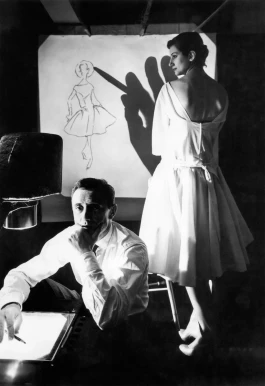
Son of a hotelier, a Rochelais, from the sunny Atlantic Old Port, la Ville Blanche. Guy Laroche: calm, elegant, discreet. The type of man who smokes a cigarette, reads the morning paper while sipping his coffee. The type of man with trousers neatly pressed, a crease down the front. The type of man who tunes into any woman’s personal style before she does: ‘sometimes she won’t know it, but you have to feel what she’s ready to wear’1.
A milliner from the start, a couturier by design, would the two ever meet? From Paris to New York, he settles down in the French capital to assist Jean Dessès, one of the Big Four 1950s haute couture designers, for five consecutive years. From millinery to couture, there is he, learning through the art of flou and draping. One day, ready to start his own chapter, he opens his first atelier at what the press dubbed ‘the smallest couture house in Paris’.
Goes without saying, by the end of the decade, Laroche is part of the couture new wave. Name them: Givenchy, Pierre Cardin and Yves-Saint- Laurent, among others.
With softness and colours, ease and charm, his designs democratised a universe previously exclusive to the elite in twice-a-year collection displays. For Laroche, ‘In prêt-à-porter, you can get close to haute couture’2. Details mattered, whether it was a cowl neck pattern, carefully folded and stitched to hold shape, or a moody sleeve with a larger-than-usual cuff circumference. Distinctive, too, the bubble dress, excess volume yet free movement. Diverted, the tweed suit: a morning jogging staple for miss d’Ornano, French aristocrat of the family behind cosmetic brands Orlane and Sisley. One can only imagine her brushed hair, lipstick on, waving to her neighbours while trotting along. Madame Pompidou, wife of the then French president, a client too. She, who longed to live in trousers, aye. Some jogged in suits, others swore best by strides.
But digressions aside, what about the ordinary women, too? The Jane Does in the crowd? Part of a mixed high-middle class; or a 1980s Parisian bride-to-be, conjuring for a Guy Laroche wedding dress. Couture or prêt-à-porter, beauty or mundane, freedom or restraint… was this all a dream? But dreams are ‘nothing but vain fantasy’3.
Bright, glassy shell,
frantic to escape dimness
a chrysalis aches to break conventions,
delicate and fragile as the thread of life.
Here, plain and bare,
a woman but a child
flying out into life, with such determination,
that little or nothing but death can halt the metamorphosis.
There, some vain shadow in the approach of fate
against her thin and diminutive body… turned erotic
—‘Chase this carefree, frail shape.’
—‘Vanish her enthusiasm.’
is it doomsday? Close, it is,
that might damage her new-born wings.
—‘Yes, turn her bliss stiff and bare.’
Back to La Rochelle, at the dawn of filming Yves Robert’s 1972 The Tall Blond Man with One Black Shoe. With no costume designer on set, Mireille asks Laroche, her friend, for help. They spend nights together, in her apartment, brainstorming, fitting, tweaking. Objective: bring dimension to her character. One of the dresses, named Clair de fesses (a cheeky play on Clair de lune), drives eroticism to a low point on Mireille’s svelte, young body, reaching far beyond the expectations of decency at that time4. Surprise, surprise, her screen partner, unaware of the ace up her sleeve or,
really, down her back, is genuinely caught off guard presented with an austere high neck in front, and a rather indecent plunge at the back. ‘It’s beautiful… (says he as he looks at her lower end) here’5.

© Guy Laroche Maison Heritage
Punctuated with a gold chain to the back, probably a nod to cultural shifts and her character’s liberation, if Mireille wanted to make a mark, she and Guy Laroche had certainly made their own. Ironically, the chain got lost over time. But the dress itself can be found at Musée des Arts Décoratifs in Paris, unlike the rest of Mireille’s collection, which she sold at auction. She could not bear ‘to see another pair of cheeks in it’6. A dress well iterated by the likes of Alexander Wang or Givenchy, famously picked up by Tom Ford during his time at Gucci and more recently from Demna’s Gucci Fall 2026 debut. Laroche, innovative in his own way, decided on every little detail. Eve Ruggieri, his friend and French television presenter, suggested that he passed away soon after his last collection in 1989, perhaps ‘because there was nothing strong enough anymore for him to make a point’7. He, who loathed eccentricity, glitz and glamour. Calm, elegant, discreet – qualities appreciated in his designs, juxtaposed with colourful and bold details. And the rest, by any other means, should have been history.
But the maison changing hands and direction contributed to the trigger of a fall. Oh, had it known difficulties before: a first crisis in the 1970s got it almost bankrupt.
Designers followed; notably, Alber Elbaz’s second collection ‘blew out the dust of the couture house (…)’8 in Suzy Menkes’s words. But, licensing troubles, fading cultural relevance; another day, another trial. What’s in a name but a fate? A brand whose pieces can be found on Vinted for a reasonable price, compared to those of its former competitors easily worth hundreds. Guy Laroche: now the nostalgic find or the niche choice. Whether it’s those signature fragrances: Fidgi, Drakkar Noir, or the fashion-aware thrifting.
A man for the sake of his aims, a brand in the hands of change.
A chrysalis, woman, friend – ‘hide this bottom that I cannot see!’
Finally, to tell from fantasy the reality: ‘All things that are, are with more spirit
chased than enjoyed’9.
1 INA, Mort de Guy Laroche. A2 Le Journal de 13H.17/02/1989. https://www.ina.fr/ina-eclaire- actu/video/cab89007716/mort-de-guy-laroche
2 INA, Guy Laroche au salon du prêt à porter. Aujourd'hui madame – 11/11/1971. https://www.ina.fr/ina-eclaire-actu/video/i06158756/guy-laroche-au-salon-du-pret-a-porter
3 William Shakespeare, Romeo and Juliet. Act 1, scene 4.
4 David Von Grafenberg, Épisode 2 – Mireille Darc / Guy Laroche. Histoires de mode. 19 Nov 2020. https://podcasts.apple.com/es/podcast/histoires-de-mode/id1539118956?l=en-GB&i=1000499514831
5 Svetlana Bogdan,Mireille Darc in Guy Laroche. 'Le Grand Blond avec une chaussure noire', 1972. Youtube. https://www.youtube.com/watch?v=Tw5Gy7czVJA
6 Aymeric Parthonnaud, VIDÉO - Mireille Darc : l'histoire de sa robe noire dos nu dans "Le Grand Blond. RTL.28/08/2017 https://www.rtl.fr/culture/cine-series/mireille-darc-l-histoire-de-sa-robe-noire-dos-nu-dans-le-grand-blond-7789857569
7 NA, Mort de Guy Laroche. A2 Le Journal de 13H.17/02/1989. https://www.ina.fr/ina-eclaire-actu/video/cab89007716/mort-de-guy-laroche
8 William Norwich, Introducing Alber Elbaz, the Man Who’ll Put Guy Laroche Back In Your Closet. Observer. 23/02/98 https://observer.com/1998/02/introducing-alber-elbaz-the-man-wholl-put-guy-laroche-back-in-your-closet/
9 William Shakespeare, The Merchant of Venice. Act 2, scene 6.

BY CRISTINA D'ORNELLAS.
Here is a story, a story of a man’s chase,
of making a name but (for others to watch)
a name fade.
Son of a hotelier, a Rochelais, from the sunny Atlantic Old Port, la Ville Blanche. Guy Laroche: calm, elegant, discreet. The type of man who smokes a cigarette, reads the morning paper while sipping his coffee. The type of man with trousers neatly pressed, a crease down the front. The type of man who tunes into any woman’s personal style before she does: ‘sometimes she won’t know it, but you have to feel what she’s ready to wear’1.
A milliner from the start, a couturier by design, would the two ever meet? From Paris to New York, he settles down in the French capital to assist Jean Dessès, one of the Big Four 1950s haute couture designers, for five consecutive years. From millinery to couture, there is he, learning through the art of flou and draping. One day, ready to start his own chapter, he opens his first atelier at what the press dubbed ‘the smallest couture house in Paris’.
Goes without saying, by the end of the decade, Laroche is part of the couture new wave. Name them: Givenchy, Pierre Cardin and Yves-Saint- Laurent, among others.
With softness and colours, ease and charm, his designs democratised a universe previously exclusive to the elite in twice-a-year collection displays. For Laroche, ‘In prêt-à-porter, you can get close to haute couture’2. Details mattered, whether it was a cowl neck pattern, carefully folded and stitched to hold shape, or a moody sleeve with a larger-than-usual cuff circumference. Distinctive, too, the bubble dress, excess volume yet free movement. Diverted, the tweed suit: a morning jogging staple for miss d’Ornano, French aristocrat of the family behind cosmetic brands Orlane and Sisley. One can only imagine her brushed hair, lipstick on, waving to her neighbours while trotting along. Madame Pompidou, wife of the then French president, a client too. She, who longed to live in trousers, aye. Some jogged in suits, others swore best by strides.
But digressions aside, what about the ordinary women, too? The Jane Does in the crowd? Part of a mixed high-middle class; or a 1980s Parisian bride-to-be, conjuring for a Guy Laroche wedding dress. Couture or prêt-à-porter, beauty or mundane, freedom or restraint… was this all a dream? But dreams are ‘nothing but vain fantasy’3.

© Guy Laroche Maison Heritage, Mireille Darc 1972
Bright, glassy shell,
frantic to escape dimness
a chrysalis aches to break conventions,
delicate and fragile as the thread of life.
Here, plain and bare,
a woman but a child
flying out into life, with such determination,
that little or nothing but death can halt the metamorphosis.
There, some vain shadow in the approach of fate
against her thin and diminutive body… turned erotic
—‘Chase this carefree, frail shape.’
—‘Vanish her enthusiasm.’
is it doomsday? Close, it is,
that might damage her new-born wings.
—‘Yes, turn her bliss stiff and bare.’
Back to La Rochelle, at the dawn of filming Yves Robert’s 1972 The Tall Blond Man with One Black Shoe. With no costume designer on set, Mireille asks Laroche, her friend, for help. They spend nights together, in her apartment, brainstorming, fitting, tweaking. Objective: bring dimension to her character. One of the dresses, named Clair de fesses (a cheeky play on Clair de lune), drives eroticism to a low point on Mireille’s svelte, young body, reaching far beyond the expectations of decency at that time4. Surprise, surprise, her screen partner, unaware of the ace up her sleeve or,
really, down her back, is genuinely caught off guard presented with an austere high neck in front, and a rather indecent plunge at the back. ‘It’s beautiful… (says he as he looks at her lower end) here’5.
Punctuated with a gold chain to the back, probably a nod to cultural shifts and her character’s liberation, if Mireille wanted to make a mark, she and Guy Laroche had certainly made their own. Ironically, the chain got lost over time. But the dress itself can be found at Musée des Arts Décoratifs in Paris, unlike the rest of Mireille’s collection, which she sold at auction. She could not bear ‘to see another pair of cheeks in it’6. A dress well iterated by the likes of Alexander Wang or Givenchy, famously picked up by Tom Ford during his time at Gucci and more recently from Demna’s Gucci Fall 2026 debut. Laroche, innovative in his own way, decided on every little detail. Eve Ruggieri, his friend and French television presenter, suggested that he passed away soon after his last collection in 1989, perhaps ‘because there was nothing strong enough anymore for him to make a point’7. He, who loathed eccentricity, glitz and glamour. Calm, elegant, discreet – qualities appreciated in his designs, juxtaposed with colourful and bold details. And the rest, by any other means, should have been history.

© Guy Laroche Maison Heritage
But the maison changing hands and direction contributed to the trigger of a fall. Oh, had it known difficulties before: a first crisis in the 1970s got it almost bankrupt.
Designers followed; notably, Alber Elbaz’s second collection ‘blew out the dust of the couture house (…)’8 in Suzy Menkes’s words. But, licensing troubles, fading cultural relevance; another day, another trial. What’s in a name but a fate? A brand whose pieces can be found on Vinted for a reasonable price, compared to those of its former competitors easily worth hundreds. Guy Laroche: now the nostalgic find or the niche choice. Whether it’s those signature fragrances: Fidgi, Drakkar Noir, or the fashion-aware thrifting.
A man for the sake of his aims, a brand in the hands of change.
A chrysalis, woman, friend – ‘hide this bottom that I cannot see!’
Finally, to tell from fantasy the reality: ‘All things that are, are with more spirit
chased than enjoyed’9.
1 INA, Mort de Guy Laroche. A2 Le Journal de 13H.17/02/1989. https://www.ina.fr/ina-eclaire- actu/video/cab89007716/mort-de-guy-laroche
2 INA, Guy Laroche au salon du prêt à porter. Aujourd'hui madame – 11/11/1971. https://www.ina.fr/ina-eclaire-actu/video/i06158756/guy-laroche-au-salon-du-pret-a-porter
3 William Shakespeare, Romeo and Juliet. Act 1, scene 4.
4 David Von Grafenberg, Épisode 2 – Mireille Darc / Guy Laroche. Histoires de mode. 19 Nov 2020. https://podcasts.apple.com/es/podcast/histoires-de-mode/id1539118956?l=en-GB&i=1000499514831
5 Svetlana Bogdan,Mireille Darc in Guy Laroche. 'Le Grand Blond avec une chaussure noire', 1972. Youtube. https://www.youtube.com/watch?v=Tw5Gy7czVJA
6 Aymeric Parthonnaud, VIDÉO - Mireille Darc : l'histoire de sa robe noire dos nu dans "Le Grand Blond. RTL.28/08/2017 https://www.rtl.fr/culture/cine-series/mireille-darc-l-histoire-de-sa-robe-noire-dos-nu-dans-le-grand-blond-7789857569
7 NA, Mort de Guy Laroche. A2 Le Journal de 13H.17/02/1989. https://www.ina.fr/ina-eclaire-actu/video/cab89007716/mort-de-guy-laroche
8 William Norwich, Introducing Alber Elbaz, the Man Who’ll Put Guy Laroche Back In Your Closet. Observer. 23/02/98 https://observer.com/1998/02/introducing-alber-elbaz-the-man-wholl-put-guy-laroche-back-in-your-closet/
9 William Shakespeare, The Merchant of Venice. Act 2, scene 6.