BY MALÉN DENIS.

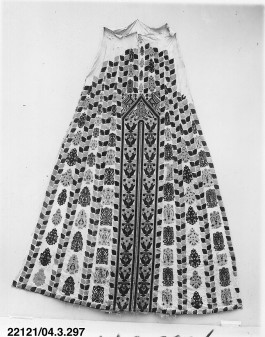
Bed tent, Greek Islands, Rhodes. 18th century
Once, I saw a video of a hermit crab looking for a shell; the crab found a can and took it as its new house/body. The memory is hazy, but the way its physiognomy changed stayed with me forever. It was another form of freedom, an improbable protection.
There is something prosthetic about that image. Dressing is always a shield— a portable house.
Hundertwasser spoke about five skins: epidermis, clothing, house, social environment, and the earth. His idea makes us realize that we are protected by layers that, even when they feel individual, are a vehicle for communal meaning. A shelter, with a coded message.

By Lola etala

By Marina Fernandez
Do we dress to be read, or is the reading of our portable home unavoidable? Dressing, as I see it, is inherently performative and double: it marks belonging while encapsulating a latent form of individual freedom.
We dress out of need; we style to express. We extend our identity through patches of fabric—soft or rough—conveying who we are and whether we plan to conquer the world or seamlessly blend into it.
A global housing crisis unfolds as people protest suffocating living conditions worldwide. But this crisis is not merely material; it is an erosion of the sense of home, linked to a deeper crisis of self. Building a home in a dematerializing context requires re-anchoring what it means to be.
We inhabit Byung-Chul Han’s world of non-things—where data displaces objects—and move through Marc Augé’s non-places, generic transitional spaces like airports or carbon-copy coffee shops from Buenos Aires to Copenhagen; modern guys dress in Dickies pants in any country in the world.
In this state of diluted uniqueness, where sustaining the rare grows increasingly difficult, we find fewer images that feel our own. We enter an era of non-fashion—where performance as an exercise of authentic identity gives way to branded markers meant purely for consumption.
This death of fashion reflects a culture struggling to grasp that despite the speed of targeted communication, identity is built through insistence and endurance. This agonizing feeling is tied to a culture of hyperconnectivity—where no one is fully present anywhere—and hyperawareness, which hastily labels anything uncomfortable so it can be sold, consumed, or ostracized.
The sense of self is atomized and commodified to such a level that originality and uniqueness seem impossible to achieve without seeing them doubled and flattened immediately after being expressed. Bodies get diluted, identities chopped, desires algorithmized.
Fashion, as a vast, complex matrix, usually speaks before its time and has the ability to push the boundaries of gender and class, because it simply operates through other forms; not fully comprehensible in words, almost illogical. No matter how much it feels that fashion will die in total-look policies, inside the copycat content of cookie-cutter influencers jumping into an outfit, there is, of course, place for yet another revolution.

By Marina Fernandez
People are gathering again—knitting, upcycling, reading poetry and books together. Social clubs, once deemed obsolete, are re-emerging to reclaim their essential role: community, exchange, and conversation.
Imagination (needed to create any social change) will have to emerge from lived experience and curiosity. Having an actual life—with its problems, desires, scents, and porosity—becomes vital: textures, techniques, your mother's voice, a lost memory recovered in conversation. Radical and serious tenderness.
Paloma Wool, one of the hottest independent brands, has been speaking fluently from domestic identity, reminding us that a true voice comes from using whatever is handy to us, being clever about what we find beautiful in life. The designer’s niece is often pictured in looks that work as a preview of the upcoming season; the AW25 campaign depicted the changing life of a mother, the shift in point of view, through the combination of domestic scenes and a classic model shoot within the same shot. These are only a few examples of attempts at speaking a language of their own—acts of resistance against an era of copying.
A possible response to a non-home era in a non-fashion world is creating homes, at other speeds: projects that value diversity, regional techniques and uniqueness, not out of the snobbery of exclusivity, but out of the political need for discourses that are less accommodating.
Labordaleza is a project that textile artist Guillermina Lynch calls an “attention territory”, in which philosophical conversations and happenings around our relationship to matter and tradition are decentralized from the art gallery circuit in Buenos Aires.
Panorama, directed by María Lee, functions less as retail and more as a thinking device. Since its beginnings in Argentina, María has been handpicking projects, not following trends but appreciating technique and history carefully.
Artisanal is not a label but an ethical process capable of rebuilding communities and reweaving links to our past—pasts that are often eroded, or that we were once taught to disown.
If we persist in trying to understand even what we don’t, and in wearing our unique points of view as if there were no other option, proudly, we will always have a home.

BY MALÉN DENIS.
Once, I saw a video of a hermit crab looking for a shell; the crab found a can and took it as its new house/body. The memory is hazy, but the way its physiognomy changed stayed with me forever. It was another form of freedom, an improbable protection.
There is something prosthetic about that image. Dressing is always a shield— a portable house.
Hundertwasser spoke about five skins: epidermis, clothing, house, social environment, and the earth. His idea makes us realize that we are protected by layers that, even when they feel individual, are a vehicle for communal meaning. A shelter, with a coded message.

By Lola Etala
Do we dress to be read, or is the reading of our portable home unavoidable? Dressing, as I see it, is inherently performative and double: it marks belonging while encapsulating a latent form of individual freedom.
We dress out of need; we style to express. We extend our identity through patches of fabric—soft or rough—conveying who we are and whether we plan to conquer the world or seamlessly blend into it.
A global housing crisis unfolds as people protest suffocating living conditions worldwide. But this crisis is not merely material; it is an erosion of the sense of home, linked to a deeper crisis of self. Building a home in a dematerializing context requires re-anchoring what it means to be.
We inhabit Byung-Chul Han’s world of non-things—where data displaces objects—and move through Marc Augé’s non-places, generic transitional spaces like airports or carbon-copy coffee shops from Buenos Aires to Copenhagen; modern guys dress in Dickies pants in any country in the world.
In this state of diluted uniqueness, where sustaining the rare grows increasingly difficult, we find fewer images that feel our own. We enter an era of non-fashion—where performance as an exercise of authentic identity gives way to branded markers meant purely for consumption.
This death of fashion reflects a culture struggling to grasp that despite the speed of targeted communication, identity is built through insistence and endurance. This agonizing feeling is tied to a culture of hyperconnectivity—where no one is fully present anywhere—and hyperawareness, which hastily labels anything uncomfortable so it can be sold, consumed, or ostracized.
The sense of self is atomized and commodified to such a level that originality and uniqueness seem impossible to achieve without seeing them doubled and flattened immediately after being expressed. Bodies get diluted, identities chopped, desires algorithmized.
Fashion, as a vast, complex matrix, usually speaks before its time and has the ability to push the boundaries of gender and class, because it simply operates through other forms; not fully comprehensible in words, almost illogical. No matter how much it feels that fashion will die in total-look policies, inside the copycat content of cookie-cutter influencers jumping into an outfit, there is, of course, place for yet another revolution.

By Marina Fernandez
People are gathering again—knitting, upcycling, reading poetry and books together. Social clubs, once deemed obsolete, are re-emerging to reclaim their essential role: community, exchange, and conversation.
Imagination (needed to create any social change) will have to emerge from lived experience and curiosity. Having an actual life—with its problems, desires, scents, and porosity—becomes vital: textures, techniques, your mother's voice, a lost memory recovered in conversation. Radical and serious tenderness.
Paloma Wool, one of the hottest independent brands, has been speaking fluently from domestic identity, reminding us that a true voice comes from using whatever is handy to us, being clever about what we find beautiful in life. The designer’s niece is often pictured in looks that work as a preview of the upcoming season; the AW25 campaign depicted the changing life of a mother, the shift in point of view, through the combination of domestic scenes and a classic model shoot within the same shot. These are only a few examples of attempts at speaking a language of their own—acts of resistance against an era of copying.
A possible response to a non-home era in a non-fashion world is creating homes, at other speeds: projects that value diversity, regional techniques and uniqueness, not out of the snobbery of exclusivity, but out of the political need for discourses that are less accommodating.
Labordaleza is a project that textile artist Guillermina Lynch calls an “attention territory”, in which philosophical conversations and happenings around our relationship to matter and tradition are decentralized from the art gallery circuit in Buenos Aires.
Panorama, directed by María Lee, functions less as retail and more as a thinking device. Since its beginnings in Argentina, María has been handpicking projects, not following trends but appreciating technique and history carefully.
Artisanal is not a label but an ethical process capable of rebuilding communities and reweaving links to our past—pasts that are often eroded, or that we were once taught to disown.
If we persist in trying to understand even what we don’t, and in wearing our unique points of view as if there were no other option, proudly, we will always have a home.

By Marina Fernandez