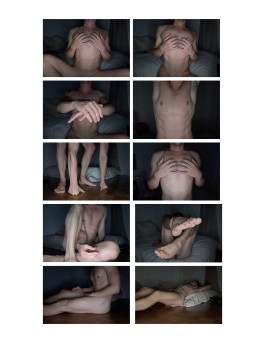
Self Portrait Notre-Dame, self-portrait, 2025
Do you remember the first image that truly made you stop?
If I look back at the first image I truly stopped at, it would be an anatomical illustration of the male body, from a biology book my Polish mother had given me. I think I was about six or seven years old. Maybe older, but I would only say that out of disbelief, because I was so young. I cut that whole book apart and glued the images to the side of my wooden wardrobe, where no one could
see them. Even then, I already understood that boys and boys was not something that was accepted. I think that is where my looking began: in secret, and with a curiosity I couldn’t stop.
Before dedicating yourself to this, what kind of life did you imagine for yourself?
As a child I wanted to become a vet or an architect. Either way, I was certain I would be shaping the physical world with my hands. Little did I know it would turn out to be something much simpler than cutting into living organisms, or than designing the spaces where such a practice could take place. The urge to handle what is real has stayed with me. Only now I do it with light. As for the life I imagine today, it looks a lot like the one I have now. I think what matters most is that I get to do what I want to do. For me, it’s important to have the space to respond to my impulses: when I want to
make something, I want to be able to do it right away, whether that’s sculptures, collages or photographs. I want to keep meeting people who inspire me, people I could work with.
When you photograph, what are you able to say or understand that you wouldn’t know how to express any other way?
Frankly, I photograph precisely the things I don’t know how to express, and for some reason they become even more elusive to me once they have been captured. My self-portraits, for example, are a wordless expression. They hold a mirror up to the viewer and become a small discovery of their own. That frees me from having to explain what I feel.

Solo hibernation, self-portrait, 2024

What do you hope to find in the exact moment you raise the camera?
What I’m looking for in an image is a way to document a certain time and place, a certain state of being. In a way, I’m trying to impress my future self by capturing the best version of who I am, so that one day I can look back and feel proud of the person I was.
When someone steps in front of you, how do you build that initial connection?
This genuinely surprised me: it doesn’t matter who is standing in front of you, there is always ice to be broken. When I started out, I assumed people would simply go for it, strike a pose, give me a look. They don’t, and that made the work much harder than I expected. Photographing other people means understanding that everyone performs. They all carry an ideal of themselves that they want to showcase; they are their own actors. For me, it’s important to make them feel that I don’t care about their ego, in the best possible way. I try to show them that I’m just like them, someone on this earth doing his thing. We talk, and slowly they begin to act naturally.
What do you find hard to look straight in the eye, both in others and in yourself?
I think it is the voices in our minds that keep us from holding someone’s gaze. To keep looking is to be confident. It means you are powerful and certain of what you are saying and doing, and yet still able to change your mind without any shame. That kind of confidence is hard to face, in others as much as in myself.


Ja sikam, self-portrait, Yashica, 2024
What place does the imperfect hold in your way of looking?
I always dream of the perfect space: perfect skin, a perfect face, a perfect smile, that neutral expression, colours that all match. Over time, though, I have learned to capture what is already there. I
want to point out that some of my images are black and white. That is a deliberate choice, a way of masking colour, and it works in their favour. Many of my self-portraits are nude, for instance. Did I wish for that perfect outfit, those perfect trousers, briefs or shirt? Yes, but I don’t have them, so I go nude. Having a strong physique matters most to me, which means clothing becomes an accessory, never a mask.
In a portrait, what do you need to remain of the person in front of you?
I think it’s important to keep the actual look of a person, the way they truly appear, not the way they wish to appear. I find it interesting when people are a little uncomfortable, because that’s when you see how they really act. Will they act out and show off, or will they fold back into themselves? There’s something so sweet about reading someone’s personality in that moment.
They become conscious of themselves. They stand still. It’s like a cigarette break: they breathe, they observe. And that pause, I think, is what needs to remain.
Do you care whether someone viewing an image understands what you wanted to tell?
I don’t mind either way. I have come to understand that we all have our own perspective. When people ask me what an image is about, I’m more than happy to give them an answer, even though my answers often raise more questions than they resolve. Honestly, I like it that way.

Middle finger on wood, paper on wood, 2026
What kind of relationship do you maintain with melancholy?
To me, melancholy is an enemy. I can’t stand her, and I’m afraid of her. She is the “he” inside me: the broke guy, and at the same time the clever woman with a strong heart. I recognise her when she appears, even when I would rather look away.

MRI Scan University Ghent As A Self Portrait, 2025

Bedroom, self-portrait, 2024
In fashion, many gazes and expectations coexist. How do you protect your own?
I protect it by deliberately not knowing the trends and by not impulsively following brands, magazines and everything else that revolves around fashion. I stay sceptical about originality and authenticity, and above all I try to tell the difference between cash-flow machines and genuine passion. That distance lets me listen to what a project needs without losing my own eye.
Is there someone you have photographed who changed the way you look?
I met this guy a couple of months ago, in a private context. We became friends, quite strongly actually, without needing many words or much time. We were so comfortable with each other that we could simply be together, even in silence. That is where I found what I had been looking for: just being, and being seen.
When a shoot deviates from the plan, do you hold on to the initial idea?
I simply give it a chance both ways. When the process starts to change the plan, I tell myself I need to stick to it. I’ve been told that’s quite Belgian of me. At the same time, I keep reading between the lines, and then I add whatever has come up along the way. It’s important for me to finish what I started.

When the work is done, do you manage to leave the camera behind?
I’m addicted to documenting. I keep a book with one page for every day of the year, and for three years now I have been printing and pasting images into it daily. Next to them I write about my day, or about the images themselves. So no, the camera never really stays behind.

18 and 19 October, personal diary, 2026

26 and 27 October, personal diary, 2026
How do you live alongside the speed of a world that produces images without rest?
Every day I hear a voice in my head telling me I’ve already lost. It is terrifying to see this many images every single day. It feels like there is simply too much to keep up with, especially when you’re making art and shooting fashion at the same time. As an artist and photographer, it’s important to stay on the grid, because you need to survive. I have zero financial support. Moving to Paris has been a hell of a ride, to be frank. Now, a year and a half in, I finally feel more at ease. I’ve realised that I can, in fact, take it slow. At first, Paris looks like a frightening train ride. Today I’m happy to feel free. I’ve found a track that holds a piece of everything I love to do. It’s important not to consume too much. Curate your mind.
If there were no limitations whatsoever, what story would you follow
For now, I find it interesting to see how our limitations bring us to where we are and shape what we do. It’s all about being creative and actually making things with what you have. I’d be happy to receive more resources, but I won’t complain about what I have. It’s my job to make it work.

19 and 20 may, personal diary, 2025

Self portrait, Summer, 2025
When you think about the coming years, what would you like photography to allow you to
experience, understand, or share?
I’m quite curious to see the professional world of fashion photography from the inside. Right now, I see my practice simply as something in progress, something still growing. I’ve only been shooting for almost two years. Seeing so many fashion photographers doing the same thing scares me; it makes me afraid of ending up doing it too. Beyond my own practice, I’d like to grow into creative direction, helping brands shape their campaigns and their identity. On a personal level, I have plans to create a small clothing label, and perhaps one day to open a gym with a raw, rugged aesthetic. But above all, I think it is my task to make photography genuine again. Images with a soul.

Butterfly, Collage, chromogenic thermal print, adhesive thermal paper, 59 x 42 cm, 2026

OCTOber, 2026
ACROSS Paris & MADRID
BY JUAN MARTI.

Self Portrait Notre-Dame, self-portrait, 2025
Do you remember the first image that truly made you stop?
If I look back at the first image I truly stopped at, it would be an anatomical illustration of the male body, from a biology book my Polish mother had given me. I think I was about six or seven years old. Maybe older, but I would only say that out of disbelief, because I was so young. I cut that whole book apart and glued the images to the side of my wooden wardrobe, where no one could
see them. Even then, I already understood that boys and boys was not something that was accepted. I think that is where my looking began: in secret, and with a curiosity I couldn’t stop.
Before dedicating yourself to this, what kind of life did you imagine for yourself?
As a child I wanted to become a vet or an architect. Either way, I was certain I would be shaping the physical world with my hands. Little did I know it would turn out to be something much simpler than cutting into living organisms, or than designing the spaces where such a practice could take place. The urge to handle what is real has stayed with me. Only now I do it with light. As for the life I imagine today, it looks a lot like the one I have now. I think what matters most is that I get to do what I want to do. For me, it’s important to have the space to respond to my impulses: when I want to
make something, I want to be able to do it right away, whether that’s sculptures, collages or photographs. I want to keep meeting people who inspire me, people I could work with.
When you photograph, what are you able to say or understand that you wouldn’t know how to express any other way?
Frankly, I photograph precisely the things I don’t know how to express, and for some reason they become even more elusive to me once they have been captured. My self-portraits, for example, are a wordless expression. They hold a mirror up to the viewer and become a small discovery of their own. That frees me from having to explain what I feel.

Solo hibernation, self-portrait, 2024
What do you hope to find in the exact moment you raise the camera?
What I’m looking for in an image is a way to document a certain time and place, a certain state of being. In a way, I’m trying to impress my future self by capturing the best version of who I am, so that one day I can look back and feel proud of the person I was.


When someone steps in front of you, how do you build that initial connection?
This genuinely surprised me: it doesn’t matter who is standing in front of you, there is always ice to be broken. When I started out, I assumed people would simply go for it, strike a pose, give me a look. They don’t, and that made the work much harder than I expected. Photographing other people means understanding that everyone performs. They all carry an ideal of themselves that they want to showcase; they are their own actors. For me, it’s important to make them feel that I don’t care about their ego, in the best possible way. I try to show them that I’m just like them, someone on this earth doing his thing. We talk, and slowly they begin to act naturally.
What do you find hard to look straight in the eye, both in others and in yourself?
I think it is the voices in our minds that keep us from holding someone’s gaze. To keep looking is to be confident. It means you are powerful and certain of what you are saying and doing, and yet still able to change your mind without any shame. That kind of confidence is hard to face, in others as much as in myself.

Ja sikam, self-portrait, Yashica, 2024
What place does the imperfect hold in your way of looking?
I always dream of the perfect space: perfect skin, a perfect face, a perfect smile, that neutral expression, colours that all match. Over time, though, I have learned to capture what is already there. I
want to point out that some of my images are black and white. That is a deliberate choice, a way of masking colour, and it works in their favour. Many of my self-portraits are nude, for instance. Did I wish for that perfect outfit, those perfect trousers, briefs or shirt? Yes, but I don’t have them, so I go nude. Having a strong physique matters most to me, which means clothing becomes an accessory, never a mask.
In a portrait, what do you need to remain of the person in front of you?
I think it’s important to keep the actual look of a person, the way they truly appear, not the way they wish to appear. I find it interesting when people are a little uncomfortable, because that’s when you see how they really act. Will they act out and show off, or will they fold back into themselves? There’s something so sweet about reading someone’s personality in that moment.
They become conscious of themselves. They stand still. It’s like a cigarette break: they breathe, they observe. And that pause, I think, is what needs to remain.
Do you care whether someone viewing an image understands what you wanted to tell?
I don’t mind either way. I have come to understand that we all have our own perspective. When people ask me what an image is about, I’m more than happy to give them an answer, even though my answers often raise more questions than they resolve. Honestly, I like it that way.

Middle finger on wood, paper on wood, 2026
What kind of relationship do you maintain with melancholy?
To me, melancholy is an enemy. I can’t stand her, and I’m afraid of her. She is the “he” inside me: the broke guy, and at the same time the clever woman with a strong heart. I recognise her when she appears, even when I would rather look away.

MRI Scan University Ghent As A Self Portrait, 2025

Bedroom, self-portrait, 2024
In fashion, many gazes and expectations coexist. How do you protect your own?
I protect it by deliberately not knowing the trends and by not impulsively following brands, magazines and everything else that revolves around fashion. I stay sceptical about originality and authenticity, and above all I try to tell the difference between cash-flow machines and genuine passion. That distance lets me listen to what a project needs without losing my own eye.
Is there someone you have photographed who changed the way you look?
I met this guy a couple of months ago, in a private context. We became friends, quite strongly actually, without needing many words or much time. We were so comfortable with each other that we could simply be together, even in silence. That is where I found what I had been looking for: just being, and being seen.
When a shoot deviates from the plan, do you hold on to the initial idea?
I simply give it a chance both ways. When the process starts to change the plan, I tell myself I need to stick to it. I’ve been told that’s quite Belgian of me. At the same time, I keep reading between the lines, and then I add whatever has come up along the way. It’s important for me to finish what I started.

When the work is done, do you manage to leave the camera behind?
I’m addicted to documenting. I keep a book with one page for every day of the year, and for three years now I have been printing and pasting images into it daily. Next to them I write about my day, or about the images themselves. So no, the camera never really stays behind.

18 and 19 October, personal diary, 2026

26 and 27 October, personal diary, 2026
How do you live alongside the speed of a world that produces images without rest?
Every day I hear a voice in my head telling me I’ve already lost. It is terrifying to see this many images every single day. It feels like there is simply too much to keep up with, especially when you’re making art and shooting fashion at the same time. As an artist and photographer, it’s important to stay on the grid, because you need to survive. I have zero financial support. Moving to Paris has been a hell of a ride, to be frank. Now, a year and a half in, I finally feel more at ease. I’ve realised that I can, in fact, take it slow. At first, Paris looks like a frightening train ride. Today I’m happy to feel free. I’ve found a track that holds a piece of everything I love to do. It’s important not to consume too much. Curate your mind.
If there were no limitations whatsoever, what story would you follow
For now, I find it interesting to see how our limitations bring us to where we are and shape what we do. It’s all about being creative and actually making things with what you have. I’d be happy to receive more resources, but I won’t complain about what I have. It’s my job to make it work.

19 and 20 may, personal diary, 2025

Self portrait, Summer, 2025
When you think about the coming years, what would you like photography to allow you to
experience, understand, or share?
I’m quite curious to see the professional world of fashion photography from the inside. Right now, I see my practice simply as something in progress, something still growing. I’ve only been shooting for almost two years. Seeing so many fashion photographers doing the same thing scares me; it makes me afraid of ending up doing it too. Beyond my own practice, I’d like to grow into creative direction, helping brands shape their campaigns and their identity. On a personal level, I have plans to create a small clothing label, and perhaps one day to open a gym with a raw, rugged aesthetic. But above all, I think it is my task to make photography genuine again. Images with a soul.

Butterfly, Collage, chromogenic thermal print, adhesive thermal paper, 59 x 42 cm, 2026